

By Izzy Grace
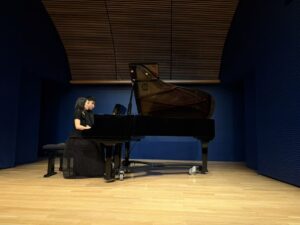
New York, NY — On Tuesday, February 24 , pianists Jianan Xu and Nan Hu, performing as the piano duo Nan Duo, present Shared Time · Shared Sound at the National Opera Center. Centered on the idea of musical time as a shared experience, the program explores collaboration as an interpretive force rather than an individual one.
Rather than offering a simple chronological survey, the program traces a conceptual arc: from spiritual meditation to human dialogue, from intimate exchange to large-scale architectural design. The recital moves from the Baroque to the late Romantic era through works for piano four hands.
The program opens with Bach’s Gottes Zeit ist die allerbeste Zeit, BWV 106, in Alan Nichols’s piano four-hand transcription. The duo meets Nichols’s sparse, restrained language with firm control, giving particular attention to shared timing and measured pacing. Within that framework, Jianan Xu anchors the performance through steady rhythmic grounding and structural continuity, while Nan Hu shapes the music’s fragile textures with refined voicing and carefully calibrated tonal balance, establishing an opening that is focused and introspective.
Mozart’s Sonata in G Major, K. 357 highlights the duo’s sense of dialogue and proportion. In that spirit, Xu sustains clarity of form and rhythmic direction, allowing ideas to unfold with clean articulation and coherence, while Hu answers with nuanced phrasing and tonal sensitivity, lending the exchange flexibility without loosening the Classical frame. Their interplay preserves an even balance, with melodic lines passing naturally between the players.
Schubert’s Fantasia in F Minor, D. 940 concludes the first half with sustained intensity. In that context, Xu guides the work’s large-scale trajectory with a clear sense of forward motion, maintaining the continuity of its architecture across shifting sections, while Hu deepens the expressive field through close attention to inner voices and harmonic color, enriching the texture while remaining integrated within the duo’s unified pacing. Their coordination keeps the performance both structurally lucid and emotionally urgent.
Following intermission, 21 Hungarian Dances for piano four hands, Wo O1, No.1 -6, shift the program toward rhythmic vitality and character-driven contrast. Rather than emphasizing symphonic weight, the duo focuses on clarity of articulation and flexibility of tempo. Xu shapes the rhythmic framework with firm control and clearly defined accents, sustaining momentum across the contrasting dances, while Hu brings precision of balance and tonal color, highlighting shifts in character and texture. Together, they maintain close coordination and responsive pacing, presenting the set as a unified sequence marked by rhythmic energy and stylistic clarity rather than surface brilliance.
Nan Duo consists of pianists Jianan Xu and Nan Hu, who have performed together as a piano duo since 2016, focusing on duo and four-hand repertoire. Their work includes duet concerts in the United States, China, and Romania, along with course content dedicated to piano-duet performance. They have also pursued music education and cultural initiatives through multi-piano benefit concerts in China, appearances at international music festivals, and outreach programs promoting ensemble piano repertoire; in 2023, they were selected as semifinalists at the Suzana Szorenyi International Duo Piano Competition in Bucharest, Romania.
Individually, Hu is a pianist and chamber musician whose work also encompasses collaborative piano across instrumental and vocal repertoire. Her performances have been recognized in international competition contexts, including a second prize at the 25th “Citta di Barletta” International Competition, as well as honors at the ‘KAWAI’ and ‘Sauter’ piano competitions. Xu is active as a soloist and chamber musician and is a member of the Shanghai Professional Pianists’ Society. Pianist Solomon Mikowsky has praised his playing for its “incredible technique and musical sensitivity.” His professional activity includes charitable programming, and in 2019 he organized and directed a multi-piano concert in Hangzhou designed to introduce audiences to a broader range of piano performance formats. He is also active in piano pedagogy and has served as a jury member for major competitions, including the Shanghai International Piano Competition.
At a time when solo piano performance remains predominant, Shared Time · Shared Sound underscores the artistic power of collaboration. Through its carefully structured program, the concert offers audiences an opportunity to consider how shared musical time and coordinated interpretation shape the expressive possibilities of piano ensemble music.

